LicenseSim guide
Hazard awareness for new drivers
Most serious crashes involving new drivers come from hazards that were visible for several seconds before they became a problem. These lessons are built around noticing them early and reacting calmly.
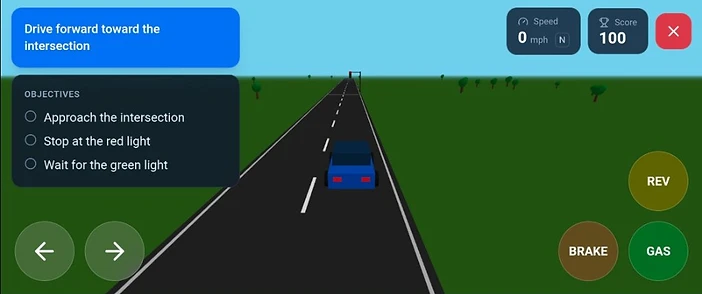
Pedestrians and animals — the Road Hazards lesson
A pedestrian steps out
Someone steps into a marked crosswalk ahead of you. Stop for them.
An animal darts out
Brake firmly rather than swerving into oncoming traffic.
Staying on the road counts
The lesson checks that you stayed on the pavement while reacting — a swerve that takes you off the road is not a save.
Emergency vehicles — the Emergency Vehicles lesson
Pull to the right
An ambulance approaches from behind with its lights and siren on. Pull to the right and stop.
Stay stopped
Stay stopped until it has fully passed before moving again.
Keep the intersection clear
Never block an intersection while you are yielding.
School buses — the School Bus Stop lesson
Red lights mean stop
A bus ahead stops with flashing red lights and its stop arm extended. Stop behind it and wait.
Do not pass
Do not pass while the arm is out, whatever the traffic around you is doing.
Wait for the lights to stop
Wait until the lights stop flashing and the arm retracts before moving off.
Hazards after dark — the Night Driving lesson
The Night Driving lesson runs the same kind of route with the light gone. You drive with your headlights on and scan ahead for pedestrians and hazards that are far harder to pick out than they are in daylight.
Open Drive — hazards without a score hanging over them
After you earn the virtual license, Open Drive runs one long route past traffic lights, marked crossings, railroad crossings, construction zones, school buses, and emergency vehicles. Mistakes there only flash a warning, so you keep driving and keep reacting instead of restarting.
Related guides
- Using a driving simulator as a new driverWhat the simulator can and cannot teach you, how the lessons and the virtual license work, and which devices it supports.Read this guide
- Parking practiceParallel parking between two cars, reversing into a bay, straight-line backing, and three-point turns.Read this guide
Common questions
What should I do if an animal runs into the road?
Brake firmly and stay in your lane. Swerving into oncoming traffic or off the road usually causes a worse crash than the animal would, and the simulator checks that you stayed on the pavement.
How far back should I stop behind a school bus?
Far enough back that you can see its rear wheels and its stop arm, and that children crossing can see you. In the simulator you must stay stopped until the red lights stop flashing and the arm retracts.
Why is night driving harder in the simulator?
The same kind of route is driven with the light gone, so pedestrians and hazards appear much later. It is a reminder to slow down and scan further ahead than you would in daylight.
Ready to try it?
Open the simulator and drive this yourself. No account needed — sign in later if you want your progress saved.